

Introduction
Tritordeum is an innovative cereal born from the crossing of wild barley (Hordeum chilense) and durum wheat, developed through conventional plant breeding. This article showcases images from our Patagonian expeditions and recounts the scientific and human story behind its creation, its nutritional traits (notably its high lutein content), and its technological potential in baking, malting/brewing, and pasta.
1) Patagonia: in search of Tritordeum’s mother
In the late 20th century, Spanish teams carried out multiple expeditions in Chile and Argentina to identify populations of Hordeum chilense—a diploid wild barley adapted to extreme ecosystems: saline coastal soils, plains between mountain ranges, stony deserts, and high-altitude zones. This ecological plasticity proved crucial—a reservoir of resilience and genetic variability for breeding.
“Saline coast, Patagonia”

Coastal shores with salt-affected soils: one of the habitats of Hordeum chilense in Patagonia.
“Plain between mountains”

Plains of Punta Arenas nestled between mountain chains, another ecological niche for the species.
2) From living collection to interspecific hybrid
The expeditions enabled the identification, classification, and collection of H. chilense accessions, creating in Spain a living collection that became the basis for hybridization with durum wheat. The result, ×Tritordeum (2n = 6x = 42; HchHchAABB), is a fertile amphiploid that combines the vigor of the wild with the agronomic reliability of the cultivated. Achieving stable lines suitable for the food supply chain required decades of selection.
“Field collecting & herbarium”

Identification and collection of H. chilense accessions at INIA in Temuco, Chile, for future evaluation in Spain.
3) Why Hordeum chilense? Traits that add value
H. chilense stands out for its crossability within the Triticeae, tolerance to biotic and abiotic stresses, and endosperm quality (pigment and protein storage). Many of these traits can be transferred to or expressed in amphiploids, delivering resilience and quality to Tritordeum.
“Wild ear detail”

Ear of Hordeum chilense, the genetic basis of Tritordeum’s golden grain tone, observed in Terra de Fuego.
4) Signature nutrients: the lutein story
A hallmark of Tritordeum is its high lutein content (≈5–8× vs. durum wheat), a carotenoid linked to the grain’s golden color and potential visual/antioxidant benefits. In Tritordeum, lutein occurs esterified, which influences retention during processing and distribution across grain fractions.
“Golden grain”

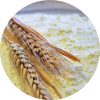
Tritordeum’s golden color is associated with its higher lutein content.
5) Food technology: baking, malting/beer, and pasta
- Baking: supple, aromatic doughs, golden crumb, and distinctive sensory profiles.
- Malting & beer: malting studies show competitive extract, consistent β-amylase, and good FAN, enabling use from 0 to 100% in grists.
- Pasta: color and texture make it ideal for specialty semolinas; recent literature highlights its versatility for health-oriented products.
“Tritordeum bread”

Bakers adopted Tritordeum for its golden crumb and warm aroma.
6) Sustainability and Mediterranean adaptation
As a crop, Tritordeum shows adaptation to Mediterranean climates, efficiency under environmental variability, and suitability for lower-input systems—attributes aligned with climate-resilience strategies and regenerative value chains.
Conclusion
Tritordeum is the outcome of a scientific and human adventure—from saline Patagonian shores and mountain habitats to fields and bakeries across Europe. Its natural hybrid origin blends the strength of the wild with the stability of cultivation, bringing color, flavor, and functionality to breads, beers, and pasta. This photo gallery documents that journey and Vivagran’s commitment to connecting biodiversity, nutrition, and food technology.
Discover the full story on Youtube:
In English
In Spanish:
In French: