

The Domestication of Tritordeum: How a New Cereal Crop was Created and what it Teaches us about the Future of Breeding
Most of the world’s cereals were domesticated thousands of years ago. Their transition from wild grasses to staple crops happened gradually, through repeated cycles of selection for harvestability, yield, grain quality, and adaptation to cultivation. Tritordeum is different. Its origin is recent, documented, and intentional. That makes it one of the clearest modern examples of crop domestication in action [1–4].
Created from a cross between durum wheat and the wild barley Hordeum chilense, Tritordeum did not simply appear as a finished crop. It had to be built over decades. Breeders and researchers first had to obtain stable amphiploids, then solve key domestication barriers such as brittle rachis and poor threshability, and later improve quality traits linked to breadmaking, carotenoid content, resilience, and end-use diversification [1,2,5–8]. Over time, Tritordeum became not only a crop in its own right, but also a model for how inter-specific breeding can expand the future of cereals [1,2].
“Tritordeum is one of the few cereals whose domestication history can be followed step by step, from the first hybrid to a usable crop.”
ARTICLE TYPE:
Tritordeum is a rare example of modern crop domestication that can be traced from its creation to its commercial development. Derived from durum wheat and the wild barley Hordeum chilense, it illustrates how a new cereal can be built through cytogenetics, chromosome engineering, agronomic selection, and end-use optimization. Its history reveals key lessons for inter-specific breeding, climate resilience, nutritional differentiation, and the future diversification of cereal crops.

- BLOG -
Check our Latest Posts


ARTICLE:
Read Mode Prevent your screen from going dark as you read.
What domestication really means
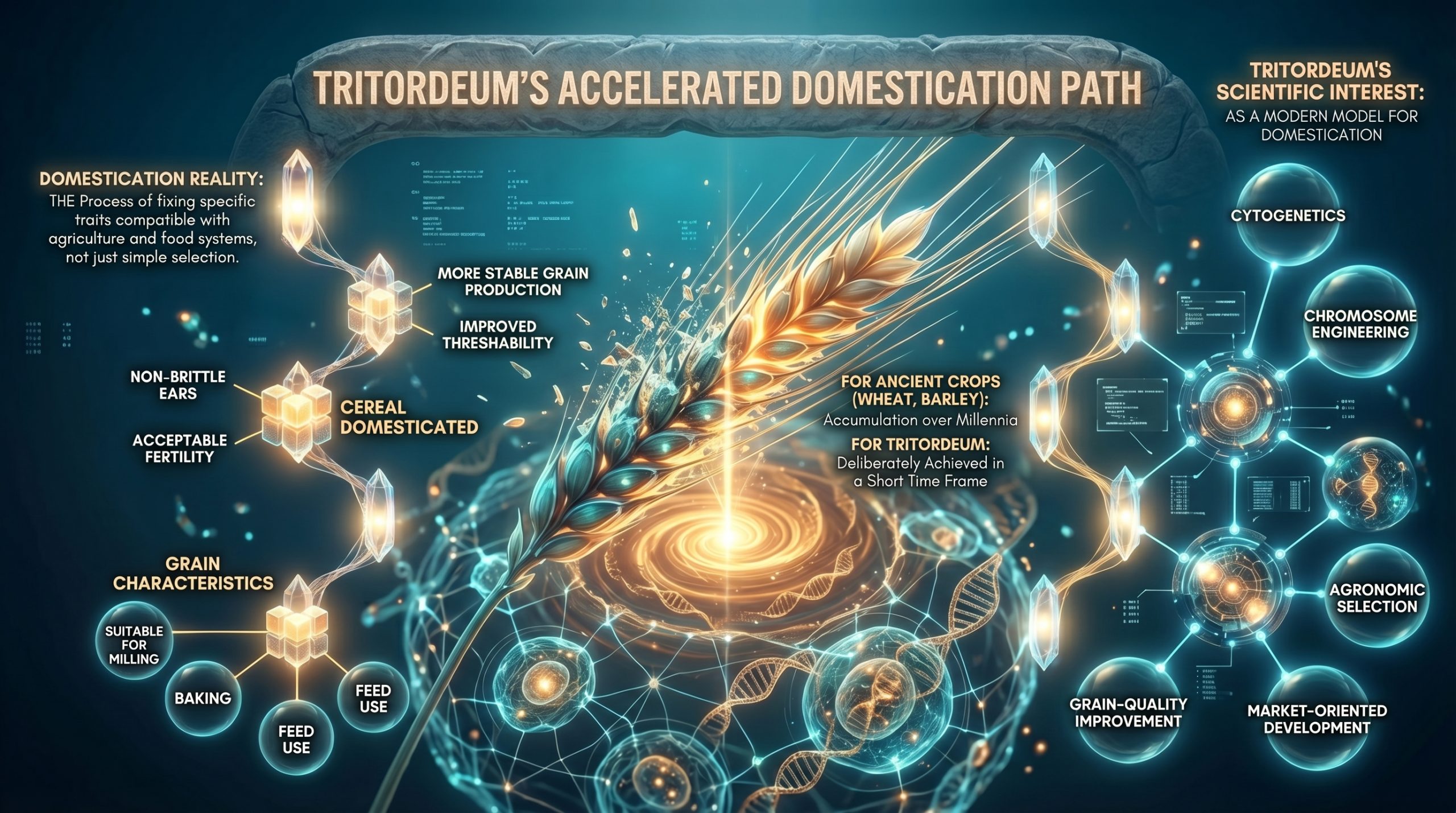
Domestication is often reduced to a simple idea: humans selected useful wild plants until they became crops. In reality, the process is much more specific. In cereals, domestication usually means fixing a suite of traits that make the plant compatible with agriculture and food systems. These traits include non-brittle ears, improved threshability, acceptable fertility, more stable grain production, and grain characteristics suitable for milling, baking, or feed use [1,3,4].
For ancient crops such as wheat and barley, these changes accumulated over millennia. For Tritordeum, they had to be achieved deliberately and in a much shorter time frame [1,2].
That is why Tritordeum is scientifically so interesting. It allows researchers to study domestication not as a distant historical event, but as a modern breeding process involving cytogenetics, chromosome engineering, agronomic selection, grain-quality improvement, and market-oriented development [1,2,7,9].
The origin of Tritordeum
Tritordeum was created through hybridization between wheat and Hordeum chilense, a wild barley species native to South America [5,6]. Early work in the late 1970s and early 1980s demonstrated that hybrids between these distant relatives could be obtained and that fertile amphiploids could be generated [5,6,10,11]. This was a major achievement in itself, because wide hybridization between species often results in sterility, chromosome instability, or highly erratic agronomic behavior [1,7].
The first challenge, therefore, was simply to make the new hybrid biologically viable. Early research focused on cytology, morphology, fertility, chromosome pairing, and ploidy [6,10–13]. Octoploid and hexaploid forms were studied, but over time hexaploid Tritordeum, derived from H. chilense and durum wheat, became the most relevant form for practical crop development [1,2,6].
This first phase can be described as pre-domestication. The crop existed, but it was not yet truly adapted to agriculture [1,3].
Why creating a hybrid is only the beginning
One of the most important lessons from Tritordeum is that generating an inter-specific hybrid is not the same as creating a crop. The hybrid may contain exciting diversity, but it also carries wild characteristics that are undesirable in agriculture [1,2,7].
In Tritordeum, two of the biggest barriers were brittle rachis and poor threshability [2,8,14]. These are classic domestication problems. In wild cereals, brittle rachis helps seed dispersal. In agriculture, it is a major disadvantage because the ear breaks too easily. Likewise, poor threshability makes grain recovery difficult after harvest [2,8].
Over the years, breeders worked to solve these traits through chromosome substitutions and introgressions. Introgression of wheat chromosomes 2D or 5D into Tritordeum was shown to lead to free-threshing habit [8]. Non-brittle rachis lines were also developed and cytogenetically characterized [14]. Later work on advanced hexaploid lines confirmed that meiotic behavior, morphology, and yield traits remained central to the domestication process even in relatively advanced materials [15].
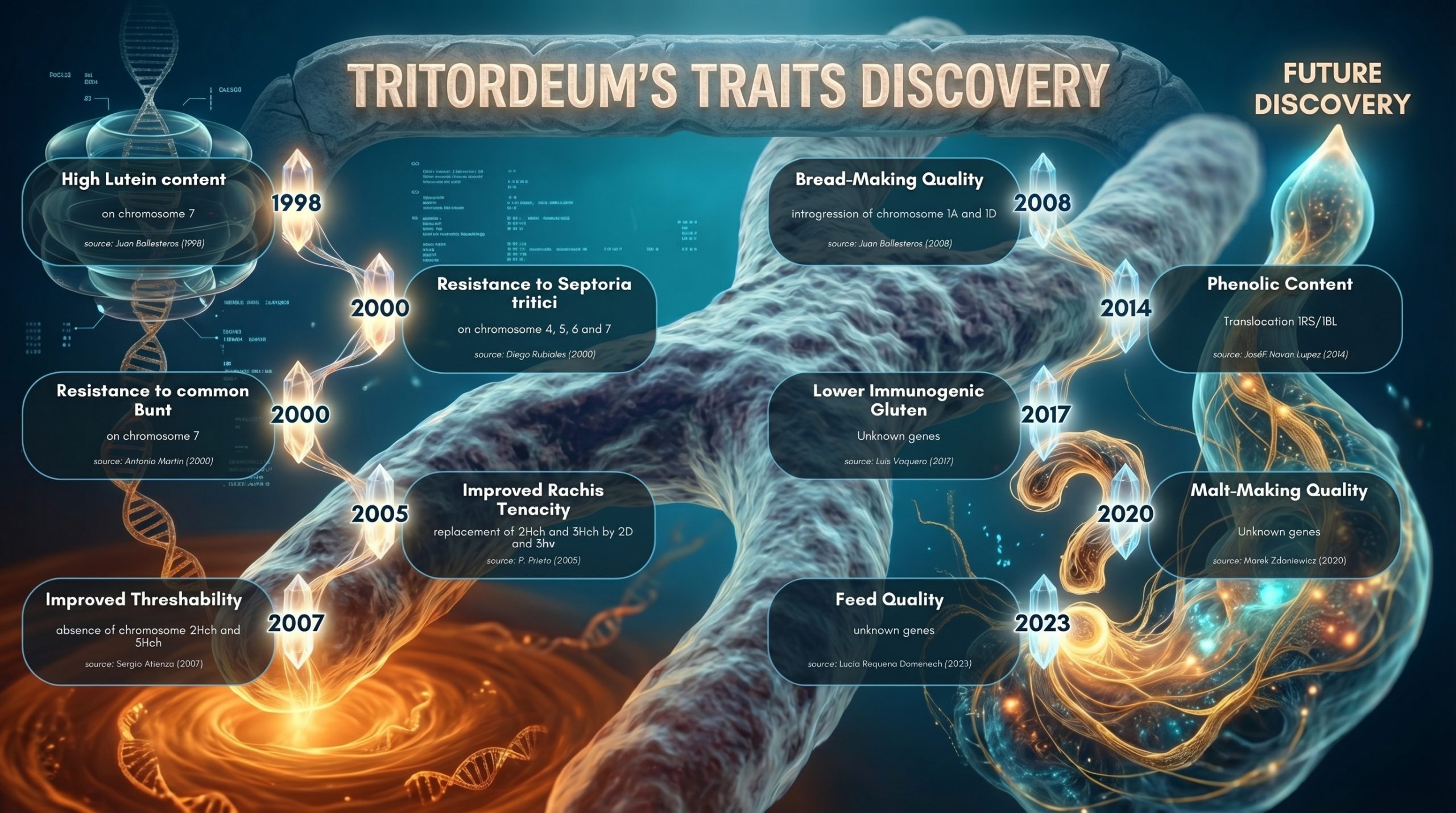
The trait history figure illustrates this domestication trajectory well, highlighting improved threshability, improved rachis tenacity, and later bread-making quality, lower immunogenic gluten, malt-making quality, and feed quality as key milestones.
| “In Tritordeum, domestication was not passive. It was an active process of keeping what agriculture needed and removing what it could not tolerate.”
A crop shaped by cytogenetics
Unlike conventional breeding within a crop species, Tritordeum development relied heavily on cytogenetics and genome analysis. Researchers tracked chromosome behavior, identified structural rearrangements, studied meiotic pairing, and used molecular markers and in situ hybridization tools to understand how the wheat and Hordeum chilense genomes interacted [7,9,16–23].
This work revealed that newly formed Tritordeum lines were not genomically static. Structural changes, genome reshuffling, and chromosome substitutions were part of the stabilization process [16–19]. While this complexity created challenges, it also offered opportunities. Specific chromosome segments from H. chilense could be associated with useful traits, opening the door to targeted breeding [20,21].
In this sense, Tritordeum has been far more than a novel cereal. It has also been a bridge system for cereal genetics, helping researchers understand how valuable wild-genome traits can be managed, stabilized, and transferred [1,2,20–24].
Domestication did not mean losing all the wild traits
A common risk in domestication is that, as a crop becomes easier to cultivate and process, it loses some of the diversity and resilience that made the wild ancestor interesting in the first place. Tritordeum shows a more strategic path [1,2].
The goal was never to erase Hordeum chilense. Instead, breeders tried to refine its contribution: remove the traits that prevented agricultural use, while preserving the traits that created value [1,2,20,24].
This is especially clear in the case of carotenoids. Tritordeum became known for its high yellow pigment content, particularly lutein, and this trait was one of the earliest major discoveries in its development history [25–34]. Over time, carotenoid research in Tritordeum moved from description to mechanism, with studies on genetic control, esterification, storage stability, tissue distribution, and processing behavior [27–34].
The result is that Tritordeum is not only a cereal with naturally golden grain. It is also a model for nutritional biofortification and a donor system for improving carotenoid content in wheat [2,24,34].
Disease resistance and resilience: another domestication dimension
Tritordeum also highlights another important dimension of domestication: the integration of adaptive traits from wild relatives.
Across the literature, Hordeum chilense and Tritordeum-related materials have been associated with resistance or partial resistance to several diseases, including powdery mildew, common bunt, and Septoria tritici [35–39,54–57]. The uploaded trait timeline specifically links common bunt resistance to chromosome 7 and Septoria tritici resistance to chromosomes 4, 5, 6, and 7.
This matters because it shows that domestication is not just about making a crop easier to harvest. It is also about deciding which wild traits should be retained because they help agriculture under real field constraints [1,2].
The same applies to drought, salinity, and nutrient efficiency. Over the years, Tritordeum has been studied under Mediterranean drought, salt stress, low-input conditions, different nitrogen regimes, enhanced-efficiency fertilizers, and multi-location field trials [58–69]. These studies suggest that Tritordeum’s value lies not in a simplistic claim of superiority, but in its resilience and plasticity under challenging conditions [62–69].
From field crop to food ingredient
Another major lesson from Tritordeum is that modern domestication extends far beyond agronomy. A cereal must also work in processing and in the market.
This is one of the strongest aspects of the Tritordeum literature. Research has covered bread-making quality, gluten composition, sourdough, starch functionality, malting, brewing, distilling, pasta enrichment, feed uses, and other applications [3,40–42,49–53,70–79]. This body of work shows that the domestication of Tritordeum was also a process of technological integration.
Bread-making quality was an early and important target [3,40,41]. Some studies identified the role of wheat chromosome introgressions, especially involving chromosome 1D, in improving dough strength and baking performance [40–42]. The uploaded trait summary highlights bread-making quality as a major milestone reached through introgression breeding.
Later, research expanded into sourdough fermentation, where Tritordeum showed promising microbial and biochemical behavior [72,73], and into malting and brewing, where it emerged as an innovative raw material with distinct performance characteristics [49–51,74–76]. The same figure identifies malt-making quality as another milestone, though the underlying genes remain unresolved.
This is a powerful message for crop development: a cereal is not truly domesticated for the modern world until it is compatible with the value chains that give it economic relevance.
A distinct nutritional identity
Tritordeum’s domestication has also produced a distinct nutritional profile. The literature includes work on carotenoids, phenolics, alkylresorcinols, tocopherols and tocotrienols, arabinoxylans, beta-glucans, minerals, resistant starch-related properties, gluten-related epitopes, and digestion behavior [27–34,43–48,80–91].
One of the most widely discussed aspects is its lower content of immunogenic gluten peptides compared with standard wheat products [45–48,88,89]. This does not make Tritordeum suitable for celiac disease, but it has helped position it scientifically as a cereal with a different gluten profile. The Vivagran timeline identifies lower immunogenic gluten as another landmark discovery.
That nutritional distinctiveness has also led to clinical and translational research, especially in gastrointestinal tolerance and IBS-related dietary studies [92–95]. In parallel, work on gut fermentation and microbial effects suggests that Tritordeum may have a broader relevance in the diversification of cereal-based diets [73,96,97].
The most important point, however, is scientific caution: Tritordeum should not be presented as a miracle cereal. Its value lies in having a different profile, not in replacing all other cereals.
What Tritordeum teaches us about inter-specific breeding
The broader significance of Tritordeum is that it offers a blueprint for breeding new crops from wide crosses.
First, it shows that wide hybridization can generate useful novelty, but that novelty is only valuable if it can be stabilized [1,2,7].
Second, it shows that domestication of a synthetic crop is multi-objective. Agronomic adaptation, quality, resilience, nutritional value, and processability all need to converge [1–3,8,40,45,49,62].
Third, it demonstrates that wild genomes can be managed rather than discarded [1,2,20,24].
Fourth, it proves that a new crop can be both a commercial species and a source of useful traits for other breeding programs [20,21,24].
For breeders working with wild relatives today, that may be the biggest lesson of all. The challenge is not merely to introgress diversity. The challenge is to turn diversity into a coherent crop phenotype.
The next phase of Tritordeum domestication
Although Tritordeum is already a real crop, its domestication is not finished. Several challenges remain.
Some beneficial traits are well documented phenotypically or chromosomally, but their precise genetic basis is still unclear [2,7,24]. In the Vivagran milestone summary, lower immunogenic gluten, malt-making quality, and feed quality are still linked to unknown genes. This suggests that modern genomics could accelerate a new phase of trait dissection and precision breeding.
Another challenge is stacking. Future cultivars will need to combine high agronomic performance, threshability, processing quality, resilience, and differentiated nutritional profiles more efficiently within the same breeding backgrounds [2,15,24].
This means Tritordeum may now be entering a new stage: not the domestication of existence, but the domestication of precision.
Conclusion
Tritordeum is one of the clearest examples of deliberate crop domestication in modern agriculture. Since its creation, it has moved from a wide hybrid with cytogenetic challenges to a cereal with defined agronomic, nutritional, and technological value [1–3].
Its history shows that domestication is not a single breakthrough. It is a long sequence of decisions: which traits to keep, which traits to remove, which genomes to stabilize, which qualities to optimize, and which markets to serve.
For cereal science, Tritordeum demonstrates that new crops can still be created. For breeding, it shows that inter-specific hybridization can be turned into lasting agricultural innovation. And for the future of food systems, it offers a compelling idea: that the cereals of tomorrow do not all need to come from the past.
| “Tritordeum reminds us that domestication is not over. In the right hands, it can begin again.”
References
- Ávila CM, et al. Tritordeum: Creating a New Crop Species—The Successful Use of Plant Genetic Resources. Plants. 2021.
- Rodríguez-Suárez C, et al. Prospects for tritordeum cereal breeding: Key points for future challenges. Plant Breeding. 2024.
- Martín A, et al. The Development of Tritordeum: A Novel Cereal for Food Processing. Journal of Cereal Science. 1998.
- Martín A. ×Tritordeum: a man-made cereal. Presentation. 2017.
- Martín A, et al. A Hybrid between Hordeum chilense and Triticum aestivum. 1977.
- Martín A, et al. Cytology and morphology of the amphiploid Hordeum chilense × Triticum turgidum conv. durum. 1982.
- Cabo SC. Inferences About Genomic Restructuring in Tritordeum Based on Molecular and Cytogenetic Markers. Thesis. 2013.
- Atienza SG, et al. Introgression of wheat chromosome 2D or 5D into tritordeum leads to free-threshing habit. 2007.
- Carvalho A, et al. Meiotic pairing and morphological and yield characterisation of three advanced lines of hexaploid tritordeum. Plant Breeding. 2024.
- Padilla JA, et al. Cytology, fertility and morphology of amphiploids Hordeum chilense × tetraploid wheats (tritordeum). 1987.
- Martín A, et al. The amphiploid Hordeum chilense × Triticum aestivum ssp. sphaerococcum: variability in octoploid tritordeum. 1987.
- Padilla JA, et al. Aneuploidy in hexaploid tritordeum. 1986.
- Vieira R, et al. Chromosome instability in intergeneric hybrids of Triticum aestivum × tritordeum with high dosage of Ph1 gene of wheat. 1991.
- Prieto P, et al. Development and cytogenetic characterisation of non-brittle rachis tritordeum lines. 2006.
- Carvalho A, et al. Meiotic pairing and morphological and yield characterisation of three advanced lines of hexaploid tritordeum. Plant Breeding. 2024.
- Cabo S, et al. Structural rearrangements detected in newly formed hexaploid tritordeum after three sequential FISH experiments with repetitive DNA sequences. 2014.
- Delgado A, et al. Genomic restructuring in Hordeum chilense durum wheat hybrids and corresponding hexaploid tritordeum lines revealed by DNA fingerprinting analyses. 2017.
- Delgado A, et al. Genomic reshuffling in advanced lines of hexaploid tritordeum. 2017.
- Castillo A, et al. High-throughput genotyping of wheat-barley amphiploids utilising diversity array technology (DArT). BMC Plant Biology. 2013.
- Palomino C, et al. Development of wheat–Hordeum chilense chromosome 2Hch introgression lines potentially useful for improving grain quality traits. Agronomy. 2019.
- Hernández P, et al. Utility of barley and wheat simple sequence repeat markers for genetic analysis of Hordeum chilense and tritordeum. Theoretical and Applied Genetics. 2002.
- Ferrer E, et al. Molecular characterization and chromosome location of repeated DNA sequences in Hordeum species and in the amphiploid tritordeum. 1995.
- González MJ, et al. Identification of wheat and tritordeum chromosomes by genomic in situ hybridization using total Hordeum chilense DNA as probe. 1999.
- Mattera MG. Introgresión de Hordeum chilense en trigo para la mejora del contenido de pigmentos carotenoides en grano. Thesis. 2017.
- Alvarez JB, et al. Chromosomal localization of genes for carotenoid pigments using addition lines of Hordeum chilense in wheat. 1998.
- Atienza SG, et al. Genetic variability of carotenoid concentration and degree of esterification among Tritordeum and durum wheat accessions. 2007.
- Mellado-Ortega E, et al. Isolation and identification of lutein esters, including their regioisomers, in tritordeum grains. 2012.
- Rodríguez-Suárez C, et al. Increase in transcript accumulation of Psy1 and e-Lcy genes in grain development is associated with differences in seed carotenoid content between durum wheat and tritordeum. 2014.
- Mattera MG, et al. Lutein ester profile in wheat and tritordeum can be modulated by temperature. 2017.
- Mellado-Ortega E, et al. Effect of lutein esterification on the differential distribution of carotenoids in germ and endosperm fractions from tritordeum grains. 2018.
- Mellado-Ortega E, et al. Carotenoid evolution during postharvest storage of durum wheat and tritordeum grains. 2015.
- Mellado-Ortega E, et al. Carotenoid evolution during short-storage period of durum wheat and tritordeum whole-grain flours. 2016.
- Mattera MG, et al. Carotenoid content in tritordeum is not primarily associated with esterification during grain development. 2020.
- Rodríguez-Suárez C, et al. Prospects for tritordeum cereal breeding: Key points for future challenges. Plant Breeding. 2024.
- Rubiales D, et al. Chromosomal location of resistance to Septoria tritici in Hordeum chilense determined by the study of chromosomal addition and substitution lines in Chinese Spring wheat. 2000.
- Rubiales D, et al. Resistance to septoria-tritici in Hordeum chilense × Triticum spp amphiploids. 1992.
- Rubiales D, et al. Reaction of tritordeum to Fusarium culmorum and Septoria nodorum. 1996.
- Rubiales D, et al. Resistance to common bunt in Hordeum chilense × Triticum spp amphiploids. 1996.
- Martín A, et al. Prospect for the use of Hordeum chilense in durum wheat breeding. 2000.
- Ballesteros J, et al. Bread-making quality in hexaploid tritordeum with substitutions involving chromosome 1D. 2003.
- Alvarez JB, et al. Influence of HMW and LMW glutenin subunits on gluten strength in hexaploid tritordeum. 1999.
- Alvarez JB, et al. Relationship between the endosperm storage proteins composition and the breadmaking quality in hexaploid tritordeum. 1995.
- Navas-Lopez JF, et al. Phenolic content variability and its chromosome location in tritordeum. Frontiers in Plant Science. 2014.
- Navas-Lopez JF, et al. Antioxidant content variability and its chromosome location in tritordeum. 2014.
- Vaquero L, et al. Tritordeum: a novel cereal for food processing with good acceptability and significant reduction in gluten immunogenic peptides in comparison with wheat. Journal of the Science of Food and Agriculture. 2017.
- Haro C, et al. Consumption of Tritordeum Bread Reduces Immunogenic Gluten Intake without Altering the Gut Microbiota. Foods. 2022.
- Marín-Sanz M, et al. Unraveling the celiac disease-related immunogenic complexes in a set of wheat and tritordeum genotypes: implications for low-gluten precision breeding in cereal crops. Frontiers in Plant Science. 2023.
- Landolfi V, et al. The effect of nitrogen fertilization on the expression of protein in wheat and tritordeum varieties using a proteomic approach. 2021.
- Zdaniewicz M, et al. Tritordeum malt: an innovative raw material for beer production. 2020.
- Yding ED, et al. Effect of malting regimes on the malt quality of tritordeum for beer brewing. 2022.
- Lee S. Effect of Germination Time and Curing Temperature on Tritordeum Malt for Low Wine Aroma. Thesis. 2023.
- Requena Domenech L. Estudio sobre la fisiología aplicada del bienestar animal del ganado ovino alimentado a base de nuevos cereales (Tritordeum y DDRR). Thesis. 2023.
- Agüera EI, et al. Promotion of Pregnant Merino Ewes’ Welfare with the Introduction of a Drought- and High-Temperature-Resistant Cereal into Their Diet. 2023.
- Rubiales D, et al. Hordeum chilense resistance to powdery mildew and its potential use in cereal breeding. 1993.
- Rubiales D, et al. Expression of resistance to Blumeria graminis f.sp. tritici in Chinese Spring wheat addition lines containing chromosomes from Hordeum vulgare and H. chilense. 2001.
- Prats E, et al. Cellular basis of resistance to different formae speciales of Blumeria graminis in Hordeum chilense, wheat, and tritordeum and agroticum amphiploids. 2006.
- Martinek P, et al. Selection of the wheat genotypes and related species with resistance to Mycosphaerella graminicola. 2013.
- Barro F, et al. Organic nitrogen content and nitrate and nitrite reductase activities in tritordeum and wheat grown under nitrate or ammonium. 1991.
- Barro F, et al. Nitrate Uptake and Reduction by Durum Wheat and Tritordeum. Journal of Plant Physiology. 1994.
- Maldonado JM, et al. Nitrate assimilation and protein accumulation in tritordeum. 1996.
- Aranjuelo I, et al. Carbon and nitrogen partitioning during the post-anthesis period is conditioned by N fertilisation and sink strength in three cereals. Physiologia Plantarum. 2012.
- Ben Mariem S. Carbon/Nitrogen Relations in C3 Cereal Crops within a Climate Change Context: Implications on Grain Yield and Quality. Thesis. 2021.
- Villegas D, et al. Tritordeum, wheat and triticale yield components under multi-local Mediterranean drought conditions. Field Crops Research. 2010.
- Yousfi S, et al. Effect of salinity and water stress during the reproductive stage on growth, ion concentrations, δ13C, and δ15N of durum wheat and related amphiploids. Journal of Experimental Botany. 2010.
- Kakabouki I, et al. Performance of six genotypes of Tritordeum compared to bread wheat under East Mediterranean conditions. Sustainability. 2020.
- Visioli G, et al. A comparative study of organic and conventional management on the rhizosphere microbiome, growth and grain quality traits of Tritordeum. Agronomy. 2020.
- Papadopoulos G, et al. Tritordeum a versatile and resilient cereal for Mediterranean agriculture and sustainable food production. 2023.
- Wyzinska M, et al. Impact of sowing date and nitrogen fertilization on two cultivars of Tritordeum yield potential – a Polish pilot study. 2025.
- Papadopoulos G, et al. Remote Sensing Meets Agronomy: A Three-Year Field Study of Tritordeum’s Response to Enhanced Efficiency Fertilisers. 2025.
- Hrušková M, et al. Quality Evaluation of the Selected Tritordeum Lines. 2010.
- Svec I, et al. Colour Evaluation of Different Pasta Samples. 2008.
- Arora K, et al. Sourdough performances of the golden cereal Tritordeum: Dynamics of microbial ecology, biochemical and nutritional features. 2022.
- Arora K, et al. In vitro faecal fermentation of Tritordeum breads and its effect on the human gut health. 2023.
- Bonne A, et al. Tritordeum as an alternative grain for brewing. Thesis. 2019.
- Demeester A, et al. Comparison of Congress Mash with Final 65 °C Mash for Wort Production with Unmalted Barley, Tritordeum, and Quinoa. 2021.
- Berski W, et al. Technological Properties of Tritordeum Starch. Applied Sciences. 2024.
- Nocente F, et al. Using Einkorn and Tritordeum Brewers’ Spent Grain to Increase the Nutritional Potential of Durum Wheat Pasta. Foods. 2021.
- Ali RFM, et al. Impact of incorporation different levels of tritordeum flour on the nutritional, quality and sensory properties of beef burger samples. 2025.
- Chiva R, et al. Yeast Biodiversity in Fermented Doughs and Raw Cereal Matrices and the Study of Technological Traits of Selected Strains Isolated in Spain. 2021.
- Rakha A, et al. Enzymatic fingerprinting of arabinoxylan and beta-glucan in triticale, barley and tritordeum grains. 2012.
- Giordano D, et al. Distribution of bioactive compounds in pearled fractions of tritordeum. 2019.
- Pedrazzani C, et al. 5-n-Alkylresorcinol Profiles in Different Cultivars of Einkorn, Emmer, Spelt, Common Wheat, and Tritordeum. 2021.
- Lachman J, et al. Tocotrienols and tocopherols in colored-grain wheat, tritordeum and barley. 2018.
- Suchowilska E, et al. The profile of bioactive compounds in the grain of various Tritordeum genotypes. 2021.
- Suchowilska E, et al. Tritordeum – the content of basic nutrients in grain and the morphological and anatomical features of kernels. 2021.
- Suchowilska E, et al. Is Tritordeum grain a potential useful source of essential minerals in the human diet. 2023.
- Shewry PR, et al. Comparative compositions of grain of tritordeum, durum wheat and bread wheat grown in multi-environment trials. Food Chemistry. 2023.
- Nitride C, et al. Tritordeum as an Innovative Alternative to Wheat: A Comparative Digestion Study on Bread. Molecules. 2022.
- Marín-Sanz M, et al. Comparative characterization of the gluten and fructan contents of breads. 2022.
- Sardella C, et al. Influence of Agronomic Practices on the Antioxidant Compounds of Pigmented Wheat and Tritordeum Genotypes. 2023.
- Sardella C, et al. The effects of milling and processing on bioactive compounds in bread wheat and tritordeum. 2026.
- Russo F, et al. Managing symptom profile of IBS-D patients with Tritordeum-based foods: results from a pilot study. Frontiers in Nutrition. 2022.
- Russo F, et al. A Comparison of the Low-FODMAPs Diet and a Tritordeum-Based Diet on the Gastrointestinal Symptom Profile of Patients Suffering from IBS-D. Nutrients. 2022.
- Riezzo G, et al. A Tritordeum-based diet for female patients with diarrhea-predominant IBS. Nutrients. 2023.
- Caponio GR, et al. Evaluation of the Effects of the Tritordeum-Based Diet Compared to the Low-FODMAPs Diet on the Fecal Metabolome of IBS-D Patients. 2022.
- de Caro S, et al. Tritordeum: Promising cultivar to improve Health. 2024.
- Mushtaq BS, et al. Development of nutritionally enhanced sourdough bread through Tritordeum bran incorporation and assessment in an in vitro gut simulation. 2025.